
I’ve spent years helping hotels source amenities from China. And I can tell you this: most "top 10 supplier" articles are useless.
They list company names. Maybe an address. Sometimes a vague claim like "15 years of experience." But they skip what procurement managers actually need—verification criteria, performance data, and due diligence frameworks.
This guide is different.
I’ll show you which Chinese suppliers have proven track records. More importantly, I’ll teach you how to verify any supplier yourself. Because the real risk isn’t picking the wrong name from a list. It’s not knowing how to separate legitimate manufacturers from trading companies pretending to be factories.
Let’s start with something most sourcing guides get completely wrong.
Why Yangzhou Is China’s Hotel Amenities Capital (And Why Most Buyers Miss It)
If you search for Chinese hotel amenities suppliers, you’ll find articles dominated by Guangzhou-based companies. This is a mistake.
The real epicenter of hotel amenities manufacturing is Hangji Industrial Zone in Yangzhou, Jiangsu Province.1
Here’s what the data shows:
| Metric | Hangji Industrial Zone Data |
|---|---|
| Market share in China | 65% |
| Global market share | 30% |
| Number of companies | 4,000+ |
| Annual sales | 30 billion yuan ($4.1 billion USD) |
That’s not a typo. One small town produces nearly one-third of the world’s hotel amenities.
Why does this matter for your procurement decisions?
Yangzhou’s concentration creates three advantages you won’t find elsewhere:
Mature supply chains. Raw material suppliers, packaging companies, and logistics providers cluster within miles of each other. This reduces lead times and costs.
Specialized labor. Workers in Hangji have produced hotel amenities for generations. Quality consistency is higher than in regions where factories jump between product categories.
Vertical integration. Many Yangzhou suppliers can source bottles, formulations, and packaging from neighboring factories they’ve worked with for decades.
When I evaluate Chinese suppliers, I always check their location first. A Yangzhou address doesn’t guarantee quality—but it does indicate the supplier operates in the industry’s most developed ecosystem.
![Image: Map showing Yangzhou’s location in Jiangsu Province, China, with Hangji Industrial Zone highlighted]
How to Verify a Chinese Supplier Before Your First Order
I’ve seen too many hotel procurement managers get burned by suppliers who looked legitimate on paper.
The most common problem? Working with a trading company pretending to be a manufacturer. They show you a nice showroom. They promise competitive prices. Then they outsource your order to the lowest bidder and pocket the difference.
Here’s my three-stage verification process:
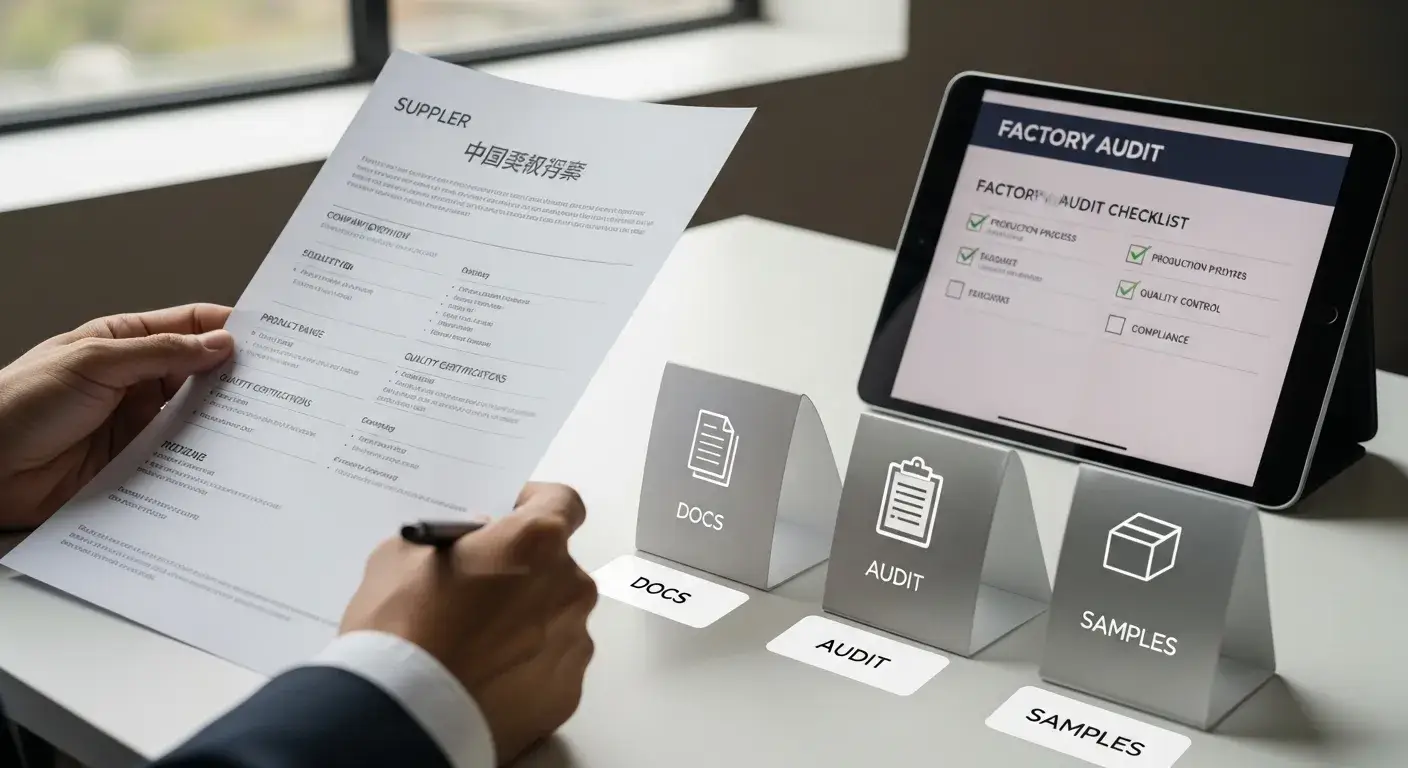
Stage 1: Documentation Check
Request these documents and actually verify them:
- Business license: Cross-check issue and expiration dates
- Export license: Required for legitimate exporters
- Certifications: Confirm with issuing bodies (SGS, TÜV, Intertek)
"Avoid self-issued or template-style documents. If a certification looks generic or lacks verifiable registration numbers, it’s probably fake."
Stage 2: Factory Audit
A factory audit costs between $250 and $400 USD. For orders worth thousands of dollars, this is the best investment you can make.
Here’s what audits reveal: A 2024 QIMA report found that only 59% of Chinese factories passed compliance reviews.2 That means 41% have issues. Without an audit, you’re gambling.
Virtual factory tours work for initial screening. But nothing replaces boots on the ground before a major order.
Stage 3: Sample Testing
Order samples from at least three suppliers. Compare:
- Material quality (weight, texture, durability)
- Scent accuracy for toiletries
- Packaging finish and print quality
- Consistency across multiple sample units
One warning: Scammers know to send good samples. They substitute inferior materials during mass production. That’s why pre-shipment inspection is essential.
10 Established China Hotel Amenities Suppliers With Verified Track Records
I’m not going to rank these suppliers from 1 to 10. That would be misleading. The "best" supplier depends on your specific needs—product category, order volume, customization requirements, and budget.
Instead, I’ve compiled suppliers with verifiable performance data. Use this as a starting point for your due diligence, not a final decision.
Yangzhou-Based Manufacturers (Hangji Industrial Zone)
1. LMZ (Jiangsu) Industrial Co., Ltd.
| Metric | Data |
|---|---|
| Investment | $60 million USD facility |
| Annual toothpaste output | 2 billion pieces (global #1) |
| Notable clients | Wyndham, Westin, Waldorf Astoria, Hilton, Mandarin Oriental |
| Sustainability | PP, PS, straw material, corn starch biodegradable products |
LMZ’s scale is staggering. Their annual toothpaste production could supply roughly six tubes for every person in the United States. This volume means competitive pricing and proven consistency.
2. Yangzhou ECO AMENITIES Co., Ltd.
| Metric | Data |
|---|---|
| Established | 2007 |
| Certifications | ISO, GMP, GRS, FSC |
| Global offices | Dubai (UAE), Los Angeles (USA) |
| Response time | Under 2 hours (industry-leading) |
| Export reach | 100+ countries |
| Notable clients | Peninsula Hotel, Anantara Hotels & Resorts |
Ecoway’s fast response time correlates with reliable production timelines. Suppliers who take days to answer inquiries typically cause delays throughout the entire order cycle.
3. Jiangsu SOHO International Group
| Metric | Data |
|---|---|
| Experience | 25+ years |
| Specialization | Hotel and airline amenities |
| Services | R&D, manufacturing, sales, service |
SOHO’s airline amenities experience means they understand strict compliance requirements. Airlines demand certifications and consistency that translate well to hotel procurement.
Guangdong-Based Suppliers
| Metric | Data |
|---|---|
| Review score | 4.9+/5.0 |
| On-time delivery rate | 98.3% |
High review scores combined with documented delivery reliability. Worth investigating for toiletries and bath products.
5. Guangzhou Winly Commodities Co., Ltd.
| Metric | Data |
|---|---|
| Experience claimed | 20+ years |
| Specialization | High-volume amenities production |
Note: I couldn’t independently verify the experience claim. Request documentation during due diligence.
| Metric | Data |
|---|---|
| Experience claimed | 15+ years |
| Specialization | Hotel toiletries |
Same verification caveat applies. Experience claims require supporting evidence.
High-Volume Specialists
| Metric | Data |
|---|---|
| Facility size | 39,000 m² |
| Reorder rate | 30% |
That 30% reorder rate stands out. Industry average hovers around 15-20%. High reorder rates indicate satisfied clients who return—a better quality signal than certifications alone.
8. Yangzhou Jetway Tourism Products Co., Ltd.
| Metric | Data |
|---|---|
| On-time delivery | 100% (reported) |
| Specialization | Hotel slippers, bathroom accessories |
Perfect delivery rates are rare. Verify through references before relying on this claim.
Emerging Suppliers Worth Monitoring
9. Jiangsu Sain
| Metric | Data |
|---|---|
| Reorder rate | 7-9% |
Lower reorder rates suggest potential service gaps. Not necessarily a dealbreaker—but ask pointed questions about client retention during negotiations.
10. Guangzhou Huiding
| Metric | Data |
|---|---|
| Reorder rate | 7-9% |
| Specialization | Budget-friendly options |
Similar retention concerns. May work for price-sensitive projects with lower quality expectations.
![Image: Infographic comparing key metrics across the 10 suppliers—facility size, certifications, reorder rates, and delivery performance]
Certifications That Actually Matter for Hotel Procurement
Not all certifications serve the same purpose. Here’s what each one tells you:
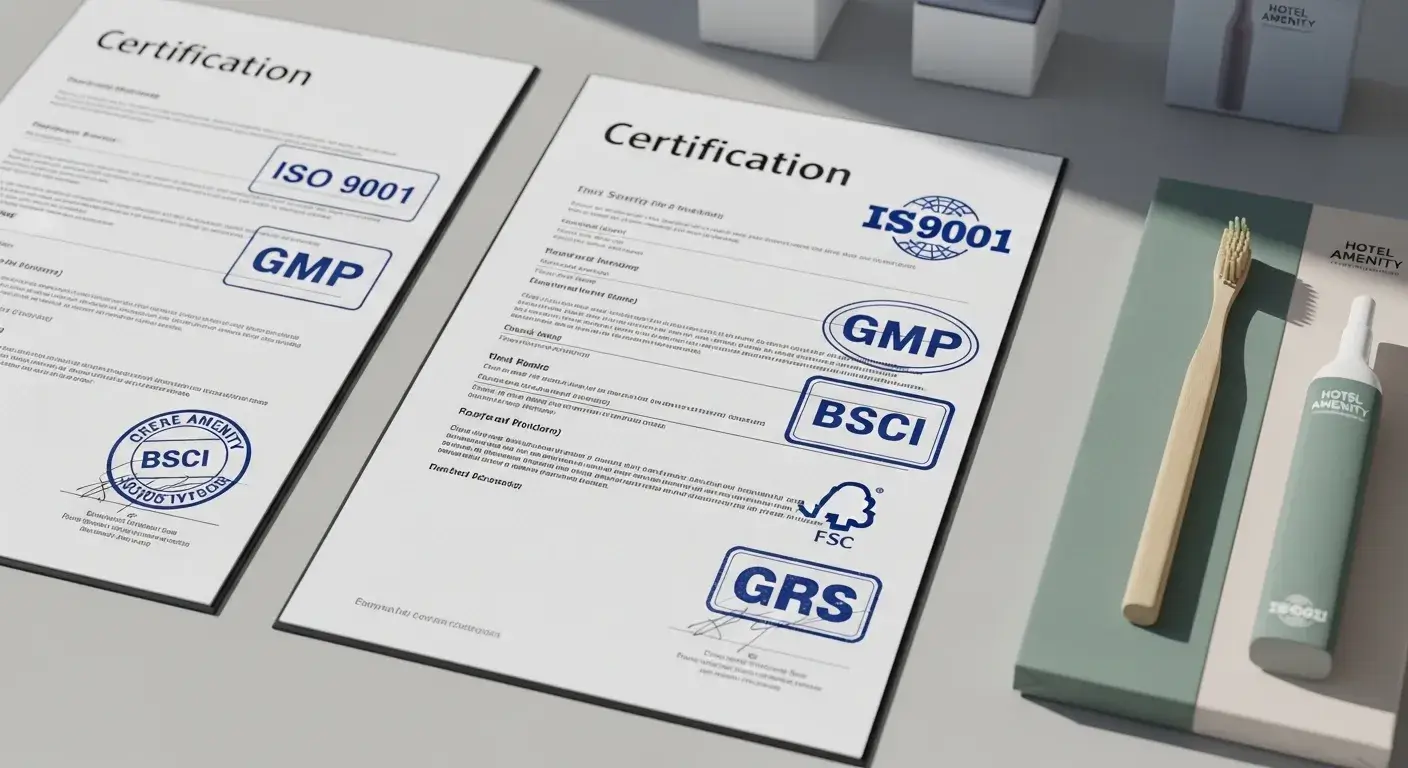
Quality Management
ISO 9001: Demonstrates documented processes for consistent quality. This is baseline. Any serious supplier should have it. The ISO 9001 standard is the most widely used quality management standard in the world, with over one million certificates issued globally.3
Manufacturing Standards
GMP (Good Manufacturing Practice): Essential for toiletries and cosmetics. GMP ensures products are consistently produced according to quality standards.4 If a supplier makes shampoo, conditioner, or lotion without GMP certification, walk away.
Ethical Compliance
BSCI (Business Social Compliance Initiative): Addresses fair wages, working conditions, and workers’ rights. The amfori BSCI program provides a recognized methodology for identifying and remediating social risks in global supply chains.5 Many hotel chains require BSCI-certified suppliers for corporate social responsibility reporting.
Sedex/SMETA: Similar to BSCI. A non-profit organization setting social compliance standards. Useful for brands emphasizing ethical sourcing.
Sustainability
FSC (Forest Stewardship Council): Required for wood-based products like bamboo toothbrushes and paper packaging.
GRS (Global Recycled Standard): Verifies recycled content claims. Important as sustainability requirements tighten.
"Always confirm certifications with the issuing bodies. SGS, TÜV, and Intertek all provide online verification tools. A certificate without a verifiable registration number is worthless."
MOQs, Lead Times, and Payment Terms: What to Expect
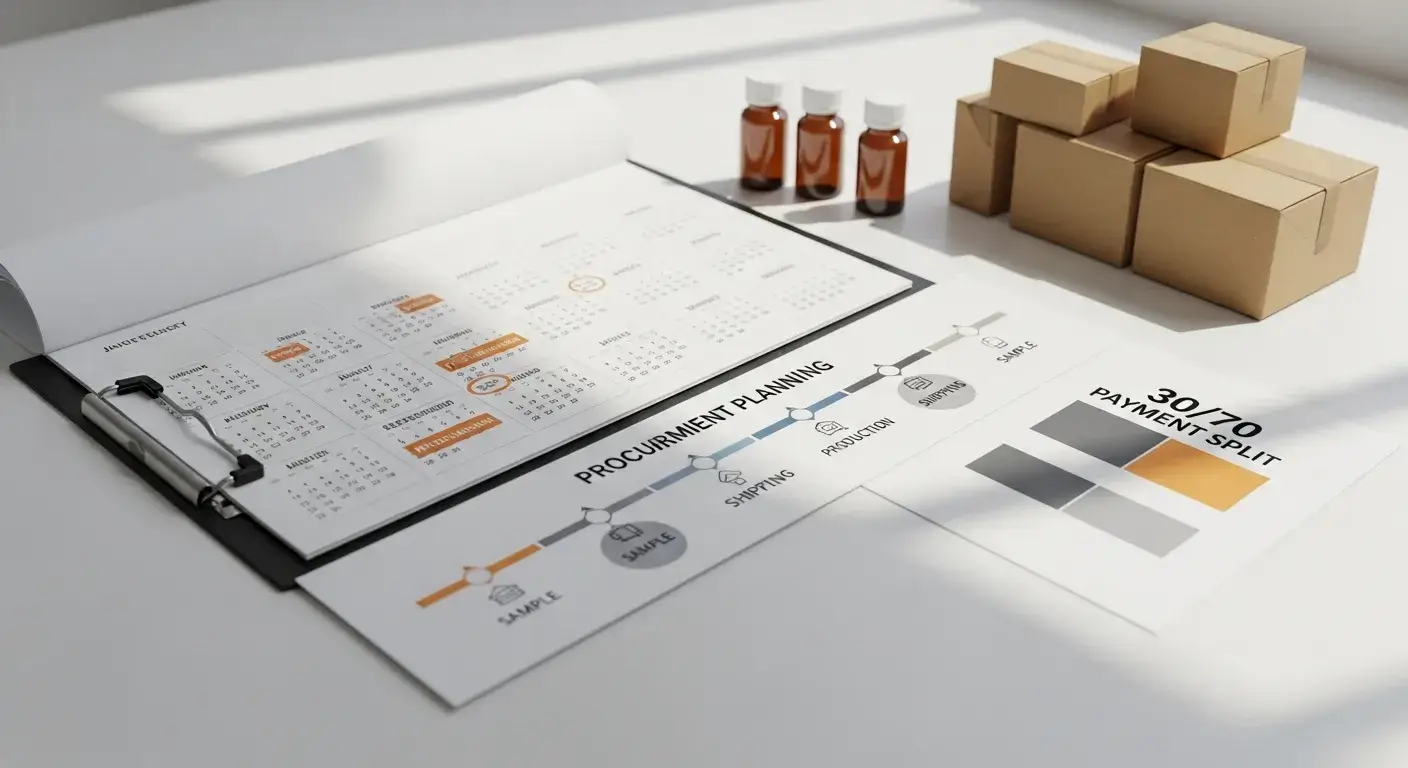
Minimum Order Quantities
| Product Category | Typical MOQ |
|---|---|
| Hotel toiletries (shampoo, soap) | 3,000-5,000 pieces |
| Biodegradable amenities | 1,000+ pieces |
| Custom OEM products | 5,000+ pieces |
Here’s something most guides won’t tell you: 85% of new importers don’t realize Chinese suppliers inflate MOQs by 30-50% as a negotiation tactic.
You can negotiate lower quantities. But be careful. Buyers who force MOQs below manufacturer recommendations experience quality issues 68% of the time within six months. The average cost of those defects? $7,800 in returns and brand damage.
Lead Times
| Stage | Timeline |
|---|---|
| Sample production | 7-15 days |
| Standard bulk production | 15-30 days after approval |
| Custom OEM production | 45-90 days |
| Total supply chain (China to US warehouse) | 50-75 days |
Plan backwards from your opening date or restocking deadline. The 50-75 day total timeline catches many first-time importers off guard.
Safe Payment Structures
30/70 Terms: Pay 30% deposit. Pay remaining 70% after pre-shipment inspection approval but before shipping. This protects both parties.
Letter of Credit: Recommended for orders exceeding $50,000. Your bank guarantees payment upon document verification.
Trade Assurance: Available on Alibaba. Funds release only after you verify goods meet specifications.
"Get your supplier’s bank account information in advance. Ask them to reference a ‘bank account information document’ on invoices rather than listing full details each time. This prevents bank account switch scams."
Sustainability Options and Upcoming Regulations
A regulatory wave is coming. Smart procurement managers are preparing now.
Key Regulatory Deadlines
| Jurisdiction | Regulation | Deadline |
|---|---|---|
| California | Single-use plastic toiletries ban | Already in effect (2023) |
| New York | Single-use plastic toiletries ban | Already in effect (2025) |
| Washington State | Single-use plastic toiletries ban | January 1, 2027 |
| European Union | Single-use plastic miniature toiletries ban | 2030 |
California became the first U.S. state to ban single-use plastic toiletries in hotels when Governor Newsom signed AB 1162 into law in 2019.6 Washington State’s mini toiletries law takes effect January 2027 for larger hotels.7
Sustainable Materials Now Available from Chinese Suppliers
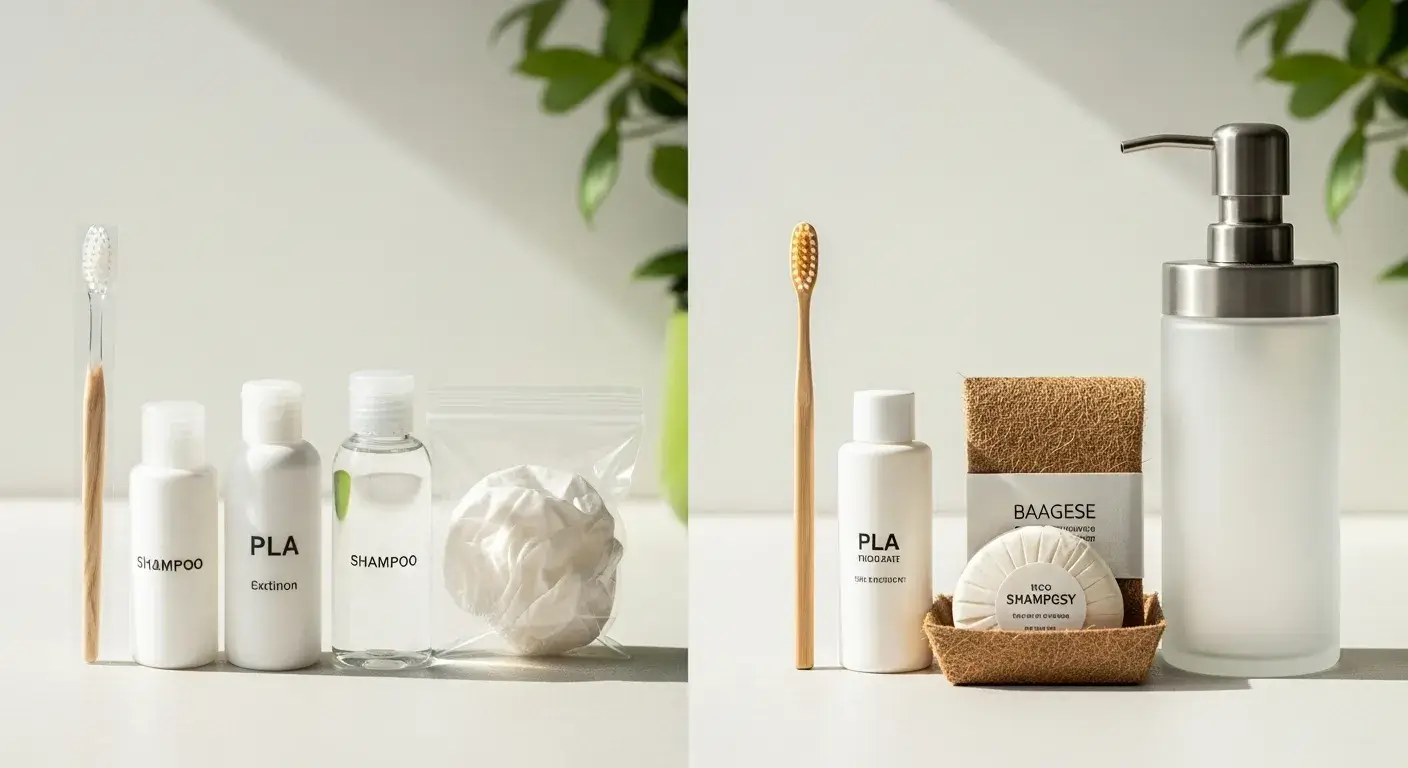
Wheat straw: Fully biodegradable within months. Used for toothbrushes, combs, and packaging.
PLA (Polylactic acid): Derived from fermented corn starch. Biodegradable alternative to traditional plastic.
Bagasse: Sugarcane fiber residue. Compostable, water-resistant, and lightweight. Ideal for packaging.
Castor oil bristles: LMZ now produces toothbrush bristles from castor oil extracts. Plant-based alternative to nylon.
Here’s the business case: 78% of travelers say they’re more likely to choose a hotel that avoids single-use plastics. Sustainability isn’t just compliance. It’s competitive advantage.
![Image: Side-by-side comparison of traditional plastic amenities versus sustainable alternatives—wheat straw, PLA, and bagasse options]
Common Sourcing Pitfalls and How to Avoid Them
Pitfall 1: Trading Companies Posing as Manufacturers
The problem: They show impressive showrooms. They quote competitive prices. But they outsource everything and disappear when quality problems arise.
The solution: Request factory tour videos showing actual production lines. Ask for export licenses (trading companies often lack these). Verify the address matches business registration documents.
Pitfall 2: Bait-and-Switch Quality
The problem: Samples look perfect. Mass production uses inferior materials.
The solution: Pre-shipment inspection is non-negotiable. When production is 100% finished and 80% packed, inspectors conduct random checks against your approved samples.
Pitfall 3: Bank Account Switching Scams
The problem: Scammers intercept invoice emails and change payment details. You send money to fraudsters.
The solution: Establish bank account information in advance. Never accept account changes via email. Verify any changes by phone using a number you obtained independently.
Pitfall 4: IP Theft
The problem: Fraudsters register YOUR brand name as THEIR trademark in China. Then they block your products from leaving the country.
The solution: Register your trademarks in China before starting OEM production. Yes, even if you’re not selling in China. China’s first-to-file trademark system allows bad-faith applicants to preempt the rights of legitimate trademark owners.8
Your Pre-Order Due Diligence Checklist
Before placing your first order with any Chinese supplier, verify these items:
Documentation Verification
- Business license confirmed (check dates)
- Export license verified
- ISO 9001 certification confirmed with issuing body
- GMP certification confirmed (for toiletries)
- BSCI/Sedex certification confirmed (if required by your chain)
Supplier Evaluation
- Factory location identified (Yangzhou = positive signal)
- Trading company vs. manufacturer status confirmed
- Reorder rate data requested (aim for >20%)
- On-time delivery rate verified (aim for >98%)
- Response time tested (<24 hours = positive signal)
Sample Testing
- Samples ordered from minimum 3 suppliers
- Material quality compared side-by-side
- Formulation consistency verified across units
- Packaging quality assessed
Commercial Terms
- MOQ negotiated to sustainable level
- Lead times documented in writing
- Payment terms agreed (30/70 recommended)
- Bank account information secured in advance
Risk Mitigation
- Pre-shipment inspection scheduled
- China trademark registration initiated
- Loading supervision arranged (for large orders)
Making Your Final Decision
The "best" China hotel amenities supplier doesn’t exist in absolute terms. The right supplier depends on your hotel’s specific needs:
For luxury properties: Prioritize suppliers with five-star client rosters (LMZ, Yangzhou Ecoway) and GMP certification.
For budget-conscious chains: Focus on high-volume producers with competitive MOQs, but don’t skip quality inspections.
For sustainability-focused brands: Verify GRS and FSC certifications. Confirm biodegradable material capabilities.
For new importers: Start with suppliers showing high reorder rates (>25%). Client retention reveals more than marketing claims.
Remember: a $300 factory audit and $200 pre-shipment inspection can prevent $10,000+ in defective inventory. Due diligence isn’t overhead. It’s insurance.
The Chinese hotel amenities market offers genuine value—if you know how to navigate it. Use the frameworks in this guide, and you’ll source with confidence instead of hope.
Looking for a supplier who handles the complexity for you? Hotemax offers verified, direct-from-manufacturer hotel amenities with transparent pricing and quality guarantees. [Contact our team] to discuss your procurement needs.
-
China Daily reports that Hangji town’s hotel supplies account for 65% of market share in China and 30% globally, with approximately 4,000 companies and annual sales reaching 30 billion yuan. ↩
-
QIMA’s Q3 2024 Barometer shows that among factories inspected in China by ethical audits in H1 2024, 59% received a "green" ranking for compliance—a five-year high for the country. ↩
-
The International Organization for Standardization (ISO) notes that ISO 9001 is the most widely used quality management standard in the world, with over one million certificates issued to organizations in 189 countries. ↩
-
The U.S. Food and Drug Administration provides GMP guidelines for cosmetic manufacturing, noting that rigorous adherence to good manufacturing practice minimizes the risk of adulteration or misbranding of cosmetics. ↩
-
Amfori BSCI provides a recognized methodology for identifying and remediating social risks in global supply chains, with a Code of Conduct based on internationally recognized standards including OECD guidelines, UNGPs, and ILO conventions. ↩
-
California Assembly Bill 1162, signed by Governor Newsom in October 2019, made California the first state to accelerate sustainable alternatives in hotels by curbing plastic consumption from miniature toiletry bottles. ↩
-
Washington State Department of Ecology confirms that plastic containers under 6 ounces for personal care products are restricted from use at lodging establishments starting January 2027 for hotels with 50+ units. ↩
-
The U.S. International Trade Administration notes that China’s first-to-file trademark registration system allows bad-faith applicants to preempt the rights of legitimate trademark owners, recommending companies file early for trademark protection. ↩