
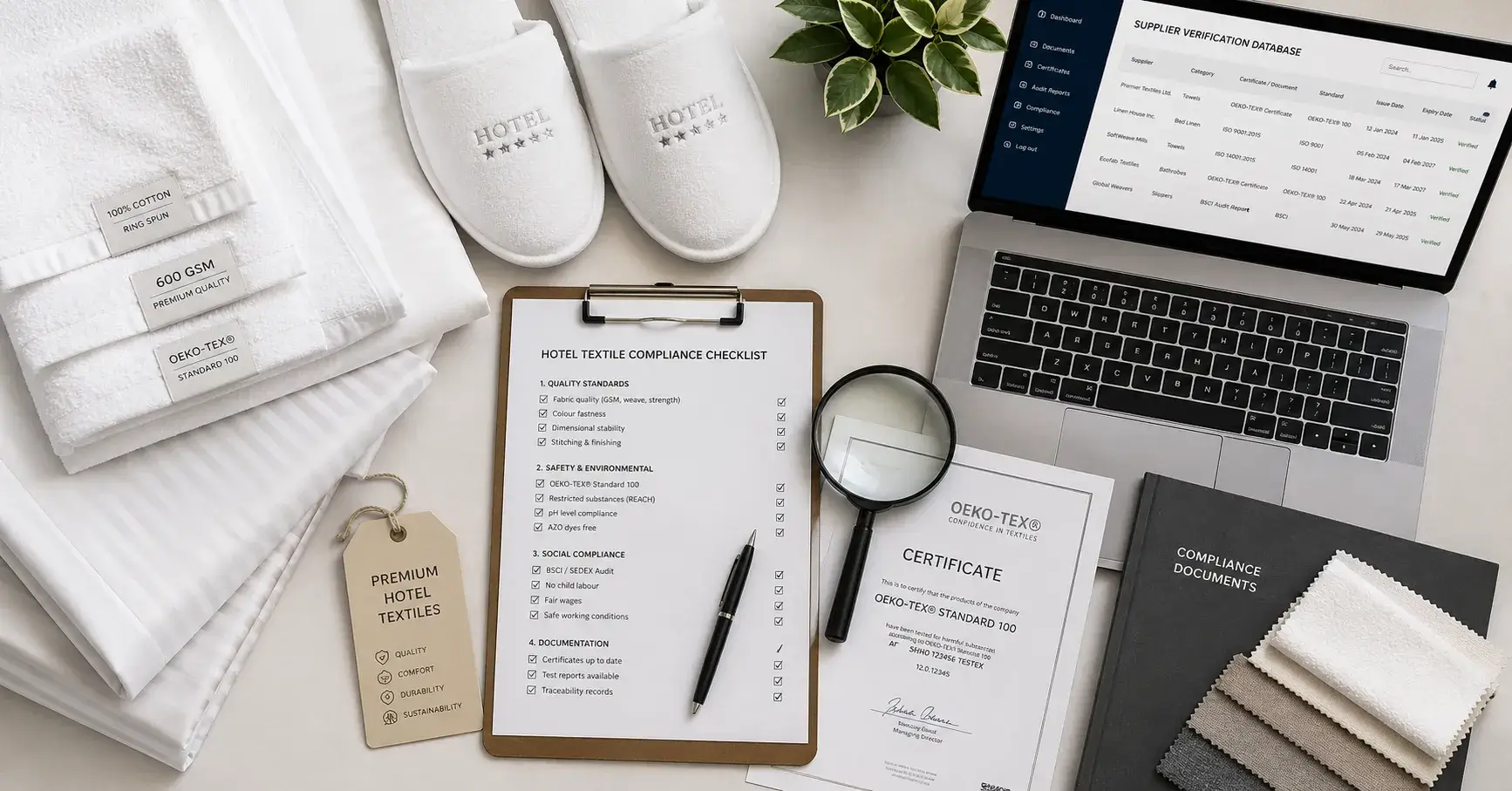
The most expensive order you’ll ever place is the one where you didn’t verify compliance first.
A detained shipment at customs. A batch of towels that fails chemical testing. Guest complaints about skin irritation from slippers that shouldn’t have passed quality control. These things happen to hotel procurement teams every year. They almost always trace back to one root cause: the buyer didn’t verify compliance before signing the purchase order.
At Hotemax, we manufacture hotel textiles, linens, slippers, and toiletries for properties across North America, Europe, and the Middle East. We go through compliance verification from the buyer’s side on every major order we fulfil. So we know what a thorough process looks like, and we know where it tends to break down.
This guide covers what "compliance" means in hospitality procurement, which documents to request, how to check if certificates are real, and how to build a verification process that works for your hotel’s size and budget.
What Does "Manufacturer Compliance" Actually Mean in Hotel Procurement?
Compliance is not a single checkbox. It covers four distinct areas, and a manufacturer can meet the standard in one area while falling short in another.
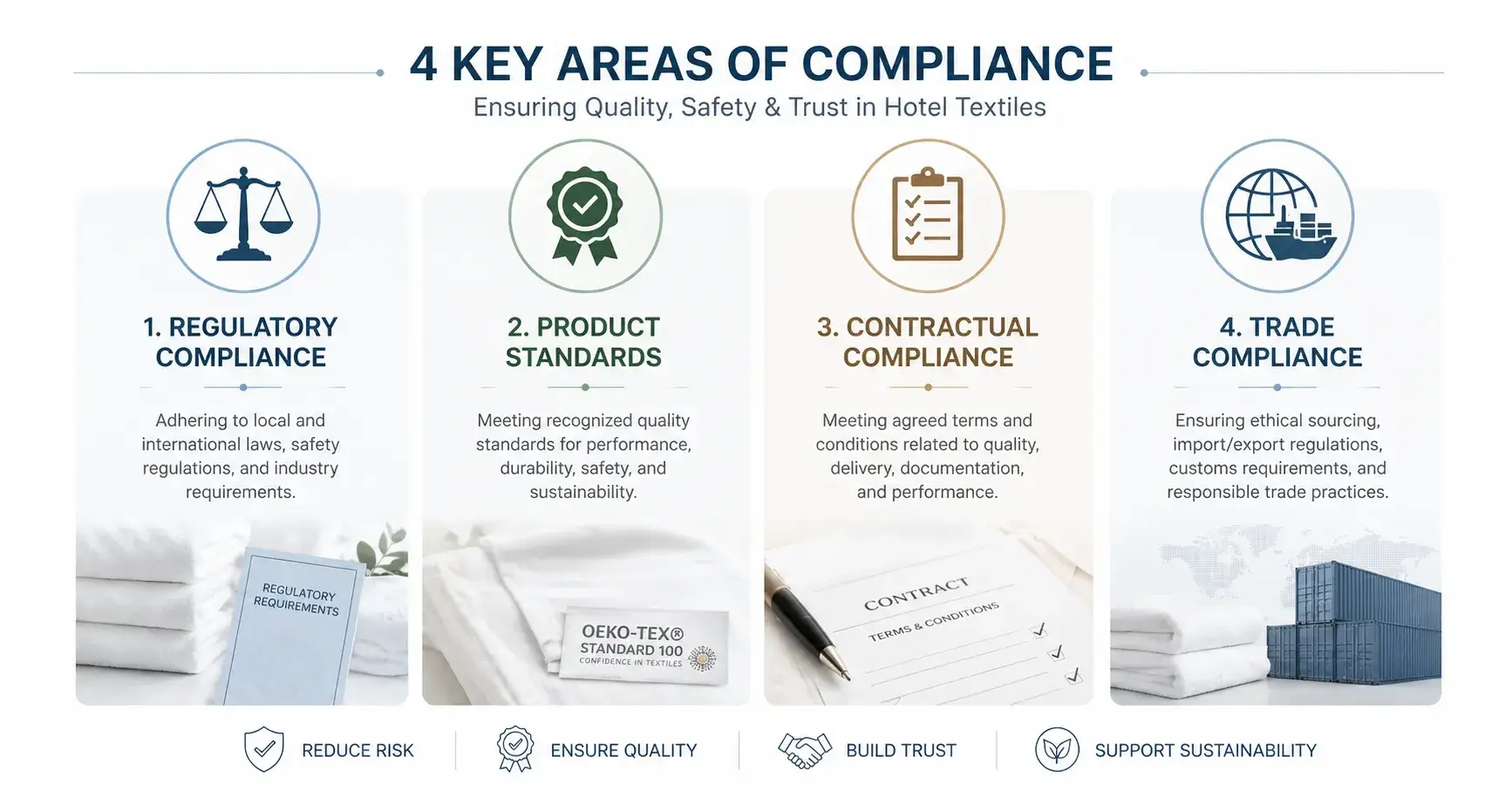
Regulatory compliance covers legal requirements in the destination market. For hotel textiles entering the EU, that means REACH regulations1 restricting chemicals like azo dyes, formaldehyde, and heavy metals. For products entering the US, it means CPSIA (Consumer Product Safety Improvement Act)2 and, for items with prolonged skin contact, potentially FDA requirements.
Product standard compliance covers voluntary or industry-recognized quality and safety benchmarks: OEKO-TEX Standard 100, GOTS, ISO 9001, and similar standards.
Contractual compliance means the manufacturer delivers what they promised. The correct GSM weight on towels. The right thread count on sheets. The agreed labeling and packaging specs.
Trade compliance covers customs and import/export rules. Correct HS codes, country-of-origin marking, and sanctions screening.
In our experience, the most common gap is between regulatory and product standard compliance. A factory may hold an ISO 9001 certificate for its quality management system while shipping products that haven’t been tested against the specific chemical limits required by REACH or CPSIA. The certificate confirms a process exists. It doesn’t confirm the product in your container meets the rules in your market.
Which Certifications and Standards Should I Look For?
The certifications that matter depend on what you’re buying and where your hotels operate.
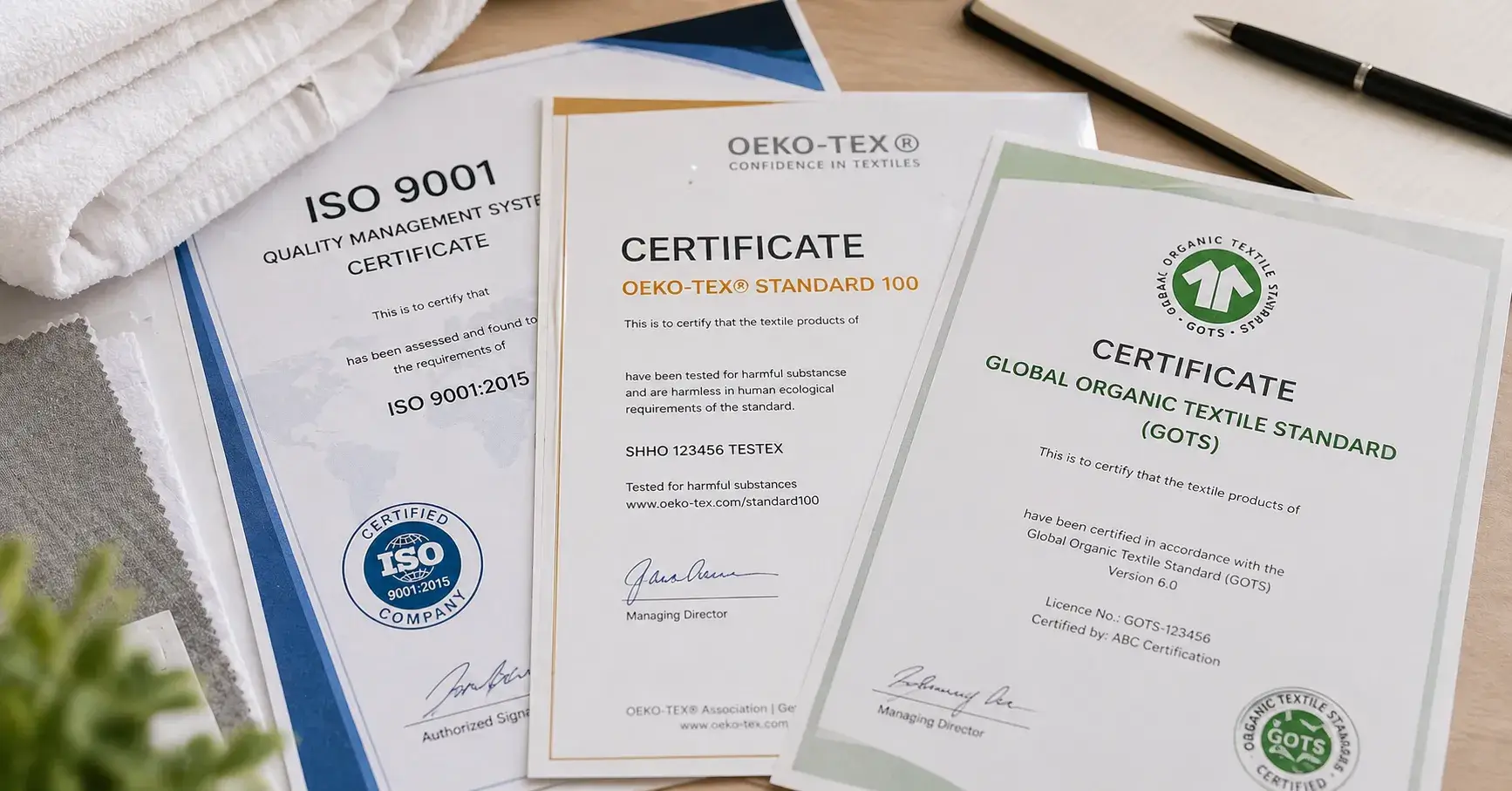
Quality Management
| Certification | What It Covers | How to Verify |
|---|---|---|
| ISO 9001 | Quality management systems | iafcertsearch.org |
| ISO 14001 | Environmental management | iafcertsearch.org |
ISO 9001 is the baseline for any serious manufacturer. But it certifies a management system, not a product. It means the factory has documented quality processes. It does not guarantee every product leaving that factory meets your specifications or your market’s regulations.
Product Safety and Chemical Compliance
| Certification | What It Covers | Why It Matters for Hotels |
|---|---|---|
| OEKO-TEX Standard 100 | Tests finished textiles for 350+ harmful substances | Covers any textile with guest skin contact: linens, towels, bathrobes, slippers |
| GOTS | Organic fiber content and processing | Required if your property makes organic claims to guests |
| REACH Compliance | EU chemical regulation | Mandatory for any textile entering the EU market |
For hotel textiles, OEKO-TEX Standard 1003 is the certification we recommend buyers prioritize. It tests the finished product for harmful substances, not just the raw materials. That distinction matters because chemicals can be introduced during dyeing, finishing, or treatment stages.
Note: The EU REACH SVHC (Substances of Very High Concern) Candidate List is updated twice per year, in January and July. As of November 2025, it includes 251 substances. A test report from 12 months ago may reference an outdated version of the list.
Social and Ethical Compliance
| Framework | Type | Platform |
|---|---|---|
| BSCI (amfori) | Audit-based | amfori platform |
| SEDEX/SMETA | Audit-based | Sedex platform |
| SA8000 | Certification-based | SAI database |
Hotel brands face growing pressure from guests and corporate ESG mandates to demonstrate ethical supply chains. If your hotel group has sustainability commitments, verify that your textile suppliers meet labor and environmental standards alongside product quality standards. SMETA audits4, powered by Sedex, are one of the most widely used social audit methodologies globally, covering labour, health and safety, environmental performance, and business ethics.
How Do I Conduct a Pre-Order Compliance Check Without Visiting the Factory?
Remote compliance verification can be thorough and reliable when you follow a structured process. Here’s the approach we recommend to our hotel clients.
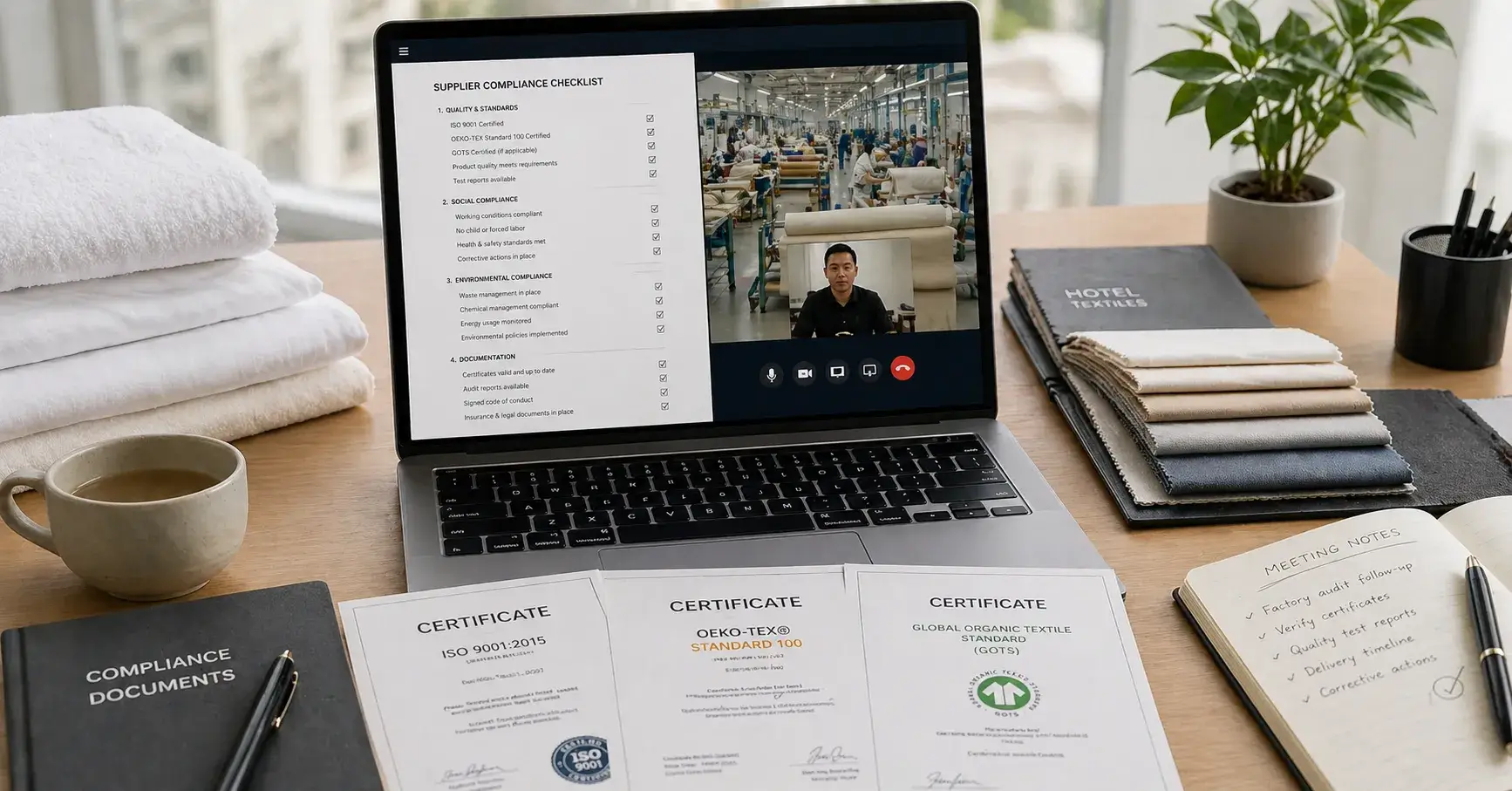
Step 1: Request the Full Documentation Package
Send your prospective manufacturer a detailed document request list. At minimum, ask for:
- Current certifications (ISO, OEKO-TEX, GOTS, etc.) with certificate numbers
- Third-party test reports for the specific product you’re ordering, not generic reports for a different product line
- Most recent factory audit report (BSCI, SMETA, or equivalent) dated within 12 months
- Product specification sheets with GSM, thread count, material composition, dimensions, and colorfastness ratings
- Safety Data Sheets (SDS) for any chemical products used in finishing or treatment
- Business license (for Chinese manufacturers, request the 营业执照)
- Supply chain traceability documentation showing where raw materials are sourced
Give them 5–7 business days. How quickly and completely they respond is itself an indicator. Manufacturers with strong compliance programs keep this documentation organized and accessible. Repeated delays or missing items deserve follow-up questions.
Step 2: Independently Verify Every Document
This is the step that makes the biggest difference. Don’t just file certificates. Verify each one against the issuing body’s records:
| Document | How to Verify |
|---|---|
| ISO certificate | Check the certificate number on the certification body’s website, then cross-reference on IAF CertSearch5 |
| OEKO-TEX certificate | Use the Label Check tool6 at oeko-tex.com |
| GOTS certificate | Search the public database at global-standard.org7 |
| Test reports | Contact the testing lab directly to confirm they issued the report, and check the lab’s ISO 17025 accreditation status |
| Chinese business license | Verify via the National Enterprise Credit Information Publicity System at gsxt.gov.cn |
Why is independent verification so important? Because fraudulent certificates are a documented, industry-wide problem. The International Accreditation Forum (IAF) has flagged cases of fake ISO certificates issued by fabricated certification bodies, some with professional websites and convincing documentation. If you’re sourcing from a new manufacturer for the first time, certificate verification is not optional.
[Editor’s note: If you have a specific example of encountering a fraudulent certificate in your procurement experience, include it here. A real case study strengthens this section significantly.]
Step 3: Commission Independent Sample Testing
Order pre-production samples and submit them to an accredited testing lab in your market. Use a lab you choose, not one the manufacturer recommends.
For hotel textiles, the key tests include:
- Chemical safety: Formaldehyde content, azo dyes (restricted aromatic amines), heavy metals, pH value, APEO/NPEO content
- Physical performance: Tensile strength, tear strength, pilling resistance, colorfastness (to washing, rubbing, and light), dimensional stability (shrinkage)
- Flammability: Based on your market’s requirements (16 CFR 1610 in the US, BS 5852 in the UK for upholstered items)
Testing costs for a standard textile panel range from $300 to $1,000 depending on scope. On an order worth $20,000 or more, that’s a small price for certainty.
Step 4: Consider a Third-Party Audit or Inspection
Third-party inspection companies like SGS, Bureau Veritas, Intertek, and TÜV offer both virtual and on-site audit services. Regional firms like QIMA specialize in Asian manufacturing.
| Service | Typical Cost | When to Use It |
|---|---|---|
| Virtual audit (video walkthrough + document review) | $500–$1,500 | First assessment of a new manufacturer, or lower-value orders |
| On-site factory audit | $2,000–$5,000+ | First order with a new manufacturer on high-value contracts |
| Pre-shipment inspection (PSI) | $250–$400 per man-day | Every production run above $10,000 |
Virtual audits became standard practice after COVID. They combine live video walkthroughs of the production floor with real-time document review and remote employee interviews. For an initial assessment or a follow-up check, they’re a cost-effective option.
What Red Flags Indicate a Manufacturer May Not Be Compliant?
These are the patterns that signal deeper problems:
Documentation delays or gaps. Manufacturers with strong compliance programs can provide their full documentation package within a week. If basic requests drag on for weeks or come back incomplete, ask why.
Certificates that can’t be independently verified. If a certificate number doesn’t appear in the issuing body’s database, or the certification body itself isn’t in any accreditation registry, treat the certificate as invalid until proven otherwise.
Wrong scope on a valid certificate. A factory may hold a legitimate ISO 9001 certificate for "production of polyester yarn" while manufacturing your finished bed linens at a different, uncertified facility. Always check that the certified scope matches your specific products and the facility producing them.
Test reports from non-accredited labs. Legitimate test reports come from labs with ISO/IEC 17025 accreditation. You can check accreditation status through the relevant national body: CNAS in China, UKAS in the UK, A2LA in the US.
Pricing significantly below market rate. If a quote comes in 25–30% below every competing bid, the savings are likely coming from cheaper materials, skipped testing, or lower labor standards. That’s not always the case, but it warrants extra scrutiny.
Refusal to allow third-party inspections. Any manufacturer that resists independent verification is telling you something important.
Inconsistency between samples and production. Manufacturers sometimes produce samples with premium materials and extra attention, then adjust for bulk production. This is why sample approval alone isn’t sufficient. During-production or pre-shipment inspections catch this gap.
How Can Digital Tools Help Me Vet a Manufacturer?
Several free databases let you verify compliance documents independently:
- IAF CertSearch (iafcertsearch.org) — global directory of accredited ISO management system certificates
- OEKO-TEX Label Check (oeko-tex.com) — verify any OEKO-TEX certificate by number
- GOTS Public Database (global-standard.org) — search for GOTS-certified facilities
- CPSC Recalls Database (cpsc.gov/Recalls8) — check for US consumer product recalls involving a manufacturer or brand
- EU Safety Gate / RAPEX — EU rapid alert system for dangerous non-food products
For larger hotel groups or centralized buying offices managing multiple supplier relationships, paid trade intelligence platforms like ImportGenius, Panjiva, or Descartes Datamyne can add another layer. These show a manufacturer’s actual export history: who they ship to, what volumes, and which product categories. This data is difficult to fabricate and can reveal inconsistencies that documentation alone won’t show. These platforms typically cost $100–$500+ per month, so they’re most practical for organizations placing large or frequent orders.
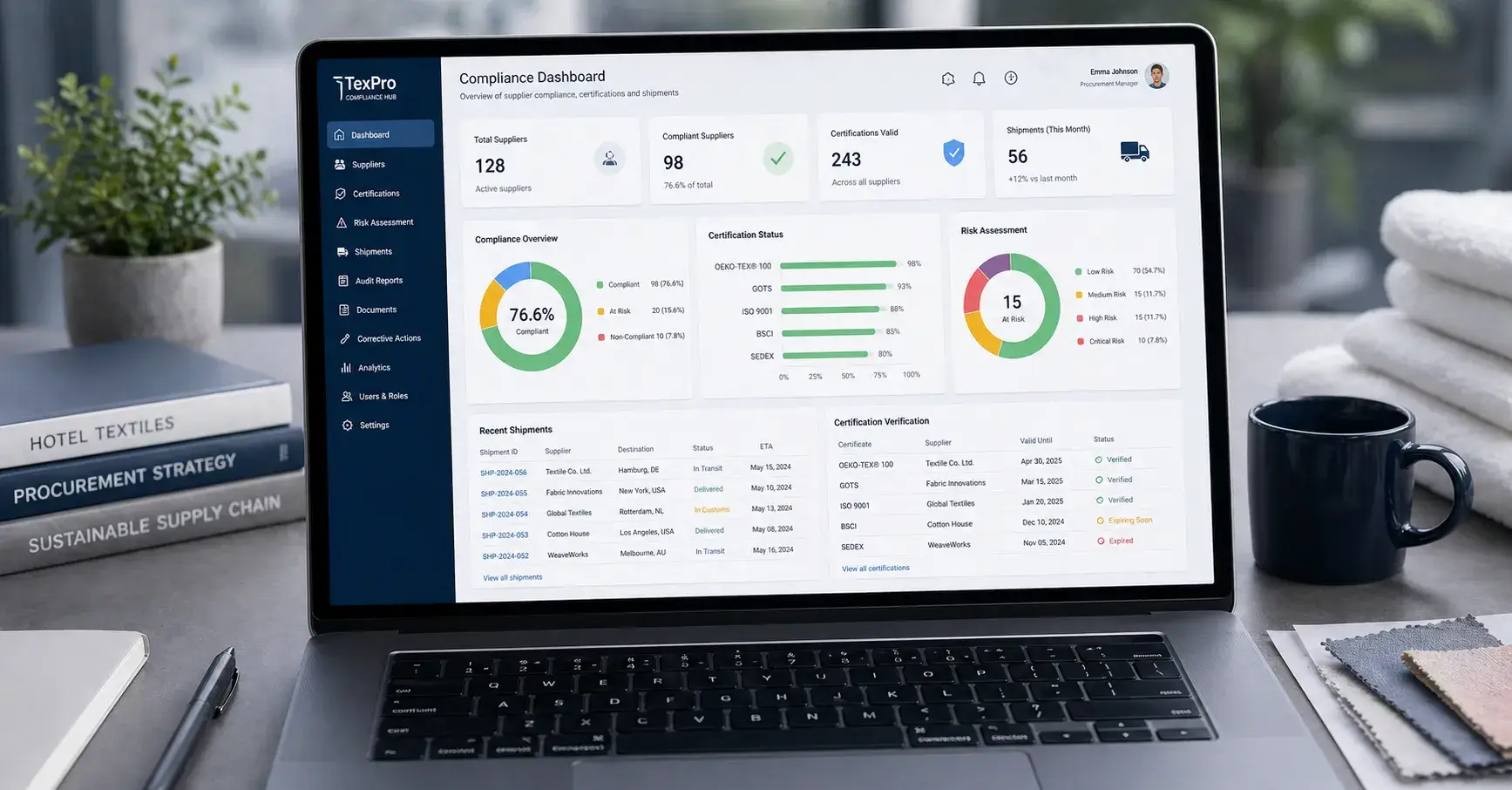
For social and sustainability auditing, the Sedex platform (membership required) provides access to SMETA audit reports, and EcoVadis offers sustainability ratings across environmental, labor, ethics, and procurement criteria.
What Happens If I Import Non-Compliant Products?
The consequences depend on your order size and market, but even at smaller scales, they’re costly:
Customs detention is the most immediate risk. Your shipment sits in a bonded warehouse at your expense while authorities examine it. Storage and demurrage charges accumulate daily. Even a routine detention can cost several thousand dollars in fees and delays before you see your goods.
Forced re-export or destruction applies if the products fail inspection. You pay return shipping or disposal costs, and you’re left without inventory for your hotel opening or seasonal turnover.
Regulatory penalties can come from the CPSC, FDA, or EU market surveillance authorities. The severity depends on the violation, but repeat issues can lead to increased scrutiny on all future shipments.
Product recalls are the worst-case scenario. If non-compliant products reach your guests and cause a health or safety issue, the financial and reputational cost escalates dramatically.
UFLPA enforcement9 is a growing factor for US importers of cotton-containing textiles. Since June 2022, US Customs and Border Protection presumes goods are made with forced labor if they have any connection to China’s Xinjiang region, unless the importer proves otherwise. The burden of proof is on you as the buyer. This applies regardless of order size.
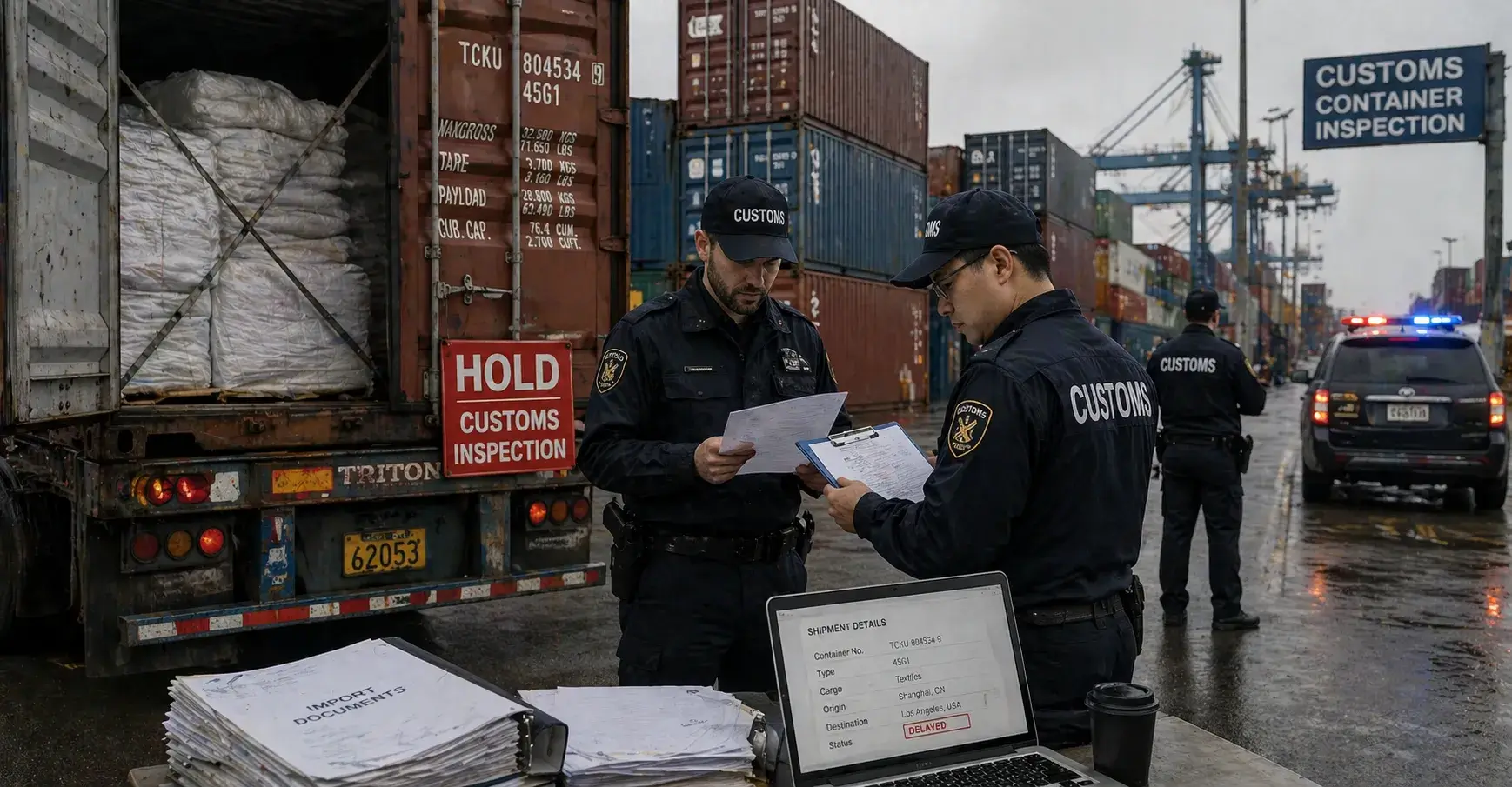
A pre-order compliance verification process, including document review, certificate checks, sample testing, and a pre-shipment inspection, typically costs $1,500–$5,000 depending on order complexity. Compare that to the cost of a single detained or rejected shipment, and the value becomes clear.
How Often Should I Re-Verify a Manufacturer’s Compliance?
The answer depends on your hotel’s procurement volume and risk tolerance.
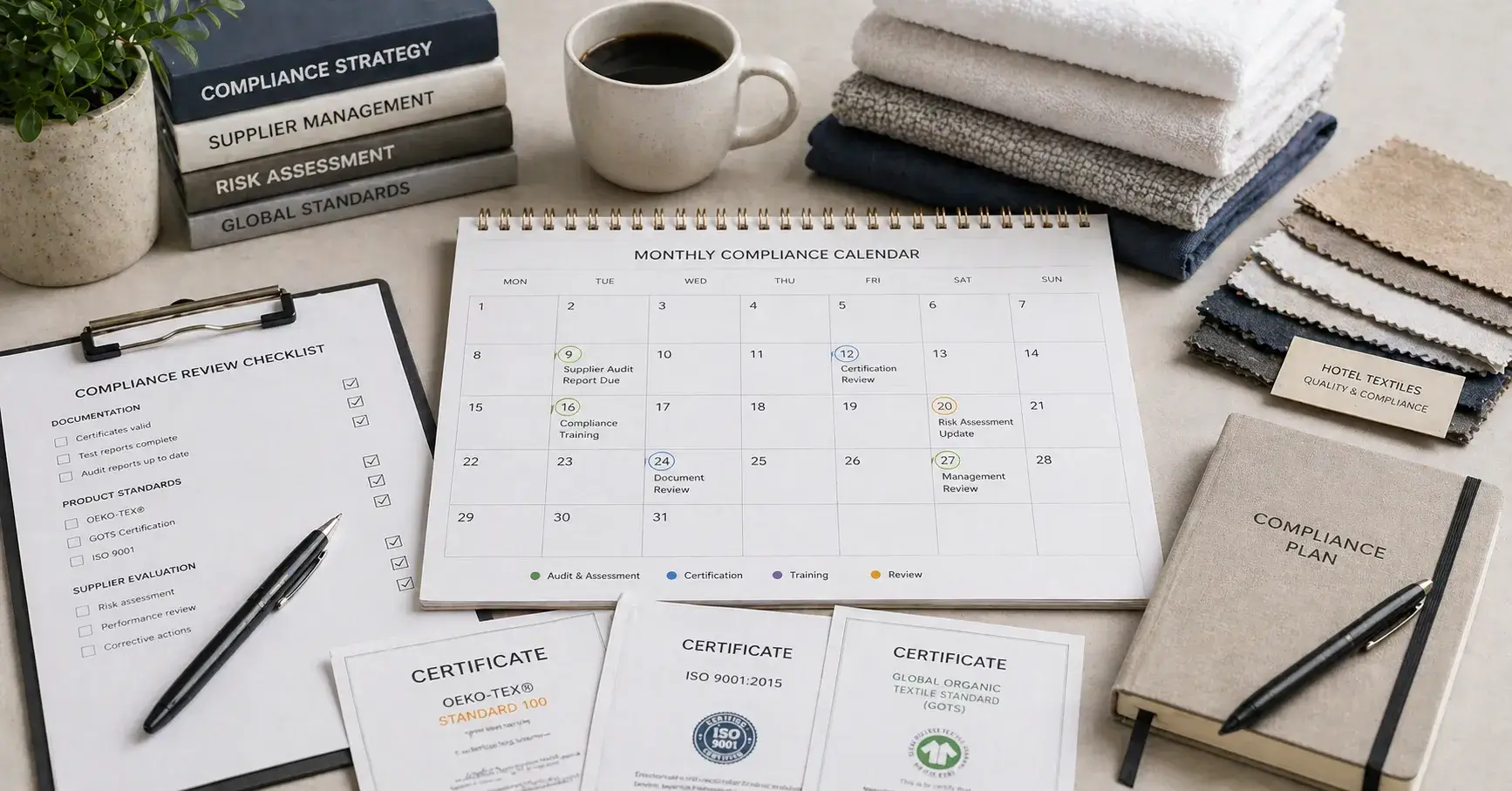
For Boutique Hotels and Small Groups (Under 200 Rooms)
- Verify certifications and request updated test reports before each new order
- Commission a pre-shipment inspection on orders above $10,000
- Re-check certificate validity dates annually
This is the practical minimum. If you’re placing one or two large textile orders per year, tying your verification to each order cycle keeps it manageable.
For Mid-Size Hotel Groups (200–1,000 Rooms)
- Everything above, plus independent batch testing on a sampling basis (every second or third order)
- Annual re-verification of all supplier certifications
- Request updated factory audit reports (SMETA or BSCI) every 12 months
- Track regulatory changes in your key markets, especially REACH SVHC updates1
For Large Chains and Management Companies
- Pre-shipment inspections on every production run
- Quarterly or semi-annual batch testing at independent labs
- Maintain a supplier scorecard tracking defect rates, documentation responsiveness, audit scores, and corrective action timelines
- Monitor supplier export activity through trade intelligence platforms
- Annual on-site or comprehensive virtual audits
After Any Significant Change (All Sizes)
Regardless of your hotel’s size, re-verify immediately when:
- The manufacturer introduces a new product line or changes materials
- The factory relocates or changes ownership
- A new raw material supplier enters the chain
- A regulation updates in your market (new REACH substances, revised CPSIA requirements)
10 Compliance Verification Insights Worth Knowing
-
Response time is a leading indicator. Manufacturers with organized compliance programs respond to document requests within a few business days. Consistent delays often predict deeper compliance issues.
-
Certificate scope matters as much as certificate validity. A valid ISO 9001 certificate for one product line or facility doesn’t cover a different product or a different factory floor. Always match the scope to your order.
-
UFLPA has changed the rules for cotton textiles entering the US. If you import cotton-containing hotel linens and can’t document the supply chain back to the raw material source, US Customs can detain the shipment. This enforcement is active and routine. You can review the latest UFLPA enforcement statistics on CBP’s dashboard10.
-
Export history is hard to fake. Trade data showing a manufacturer’s actual shipping patterns can reveal inconsistencies that polished sales presentations and documentation packages don’t.
-
Good self-assessment questionnaires ask verifiable questions. Instead of "Do you conduct product testing?", ask "What is the accreditation number of the lab that tested your most recent production run?" Specificity discourages vague or dishonest answers.
-
Lab accreditation scope varies. A lab accredited for physical textile testing (tensile strength, pilling) may not be accredited for chemical testing (formaldehyde, heavy metals). Confirm the lab’s accreditation covers the specific tests your order requires.
-
Domestic market compliance doesn’t equal export compliance. A product that meets China’s or India’s domestic textile standards may not meet EU REACH limits or US CPSIA requirements. Regulations on formaldehyde, lead, phthalates, and flame retardants differ across jurisdictions.
-
The gap between sample quality and production quality is real. Samples often receive premium materials and extra care. Bulk production may not get the same treatment. Mid-production or pre-shipment inspections are the only reliable way to catch this.
-
Supplier qualification and compliance verification serve different purposes. Supplier qualification evaluates whether a manufacturer is a good commercial fit. Compliance verification confirms whether their products meet your legal and regulatory requirements. Both are necessary. Neither replaces the other.
-
Verification costs are small relative to failure costs. Spending $2,000–$5,000 to verify compliance on a $50,000+ order is a 4–10% investment. A single detained shipment, failed inspection, or guest safety incident will cost several multiples of that.
Conclusion
Verifying a manufacturer’s compliance before placing an order takes work. But the process is straightforward once you know what to request, where to verify it, and how to scale the effort to your hotel’s size.
Start with the documentation request. Verify every certificate independently. Test samples at a lab you trust. Use third-party inspections on production runs that matter. Then build a cycle for ongoing checks so compliance doesn’t become a one-time exercise that slowly goes stale.
The right manufacturers will welcome your scrutiny. They’ve invested in compliance systems, testing, and certifications specifically so they can demonstrate them. That transparency is one of the clearest signals that you’re working with the right partner.
At Hotemax, we maintain OEKO-TEX, ISO 9001, and BSCI compliance across our hotel textile, linen, slipper, and toiletry product lines. We provide full documentation packages to our hotel clients and welcome third-party verification on every order. Get in touch if you’d like to see what that looks like in practice.
-
ECHA Candidate List — The European Chemicals Agency’s official SVHC Candidate List database, where you can view the full list of 251 restricted substances under REACH and track biannual updates. ↩ ↩
-
CPSIA Overview (CPSC.gov) — The U.S. Consumer Product Safety Commission’s official summary of the Consumer Product Safety Improvement Act, detailing testing, certification, and substance restriction requirements for consumer products entering the US market. ↩
-
OEKO-TEX Standard 100 — The official OEKO-TEX page explaining the Standard 100 certification process, testing criteria for over 350 harmful substances, and how the product class system works for different textile applications. ↩
-
SMETA Audit (Sedex) — Sedex’s official page on the SMETA audit methodology, the world’s most widely used social audit for evaluating labour standards, health and safety, environmental performance, and business ethics in supply chains. ↩
-
IAF CertSearch — The exclusive global database for validating accredited ISO management system certificates. Cross-checks data from accreditation bodies, certification bodies, and certified entities to confirm certificate authenticity. ↩
-
OEKO-TEX Label Check — The free verification tool where you can enter any OEKO-TEX certificate number to confirm its validity and view the certified product scope in real time. ↩
-
GOTS Certified Suppliers Database — The Global Organic Textile Standard’s public database for searching GOTS-certified facilities worldwide, including their certified product categories and certification body details. ↩
-
CPSC Recalls Database — The U.S. Consumer Product Safety Commission’s searchable recall database, where you can check whether a manufacturer or product has been subject to a safety recall in the US market. ↩
-
UFLPA (CBP) — U.S. Customs and Border Protection’s official Uyghur Forced Labor Prevention Act resource page, including enforcement guidance, importer FAQs, and the UFLPA Entity List for supply chain due diligence. ↩
-
UFLPA Enforcement Statistics Dashboard — CBP’s interactive dashboard showing real-time UFLPA enforcement data, including the number and value of shipments detained, released, and denied entry by industry and country of origin. ↩