

We supply hotel textiles to properties in over 30 countries. That means we sit on the supplier side of the table every day. And honestly? I can see why finding the right bedding partner feels overwhelming from the buyer’s side.
It’s not that suppliers are hard to find. A quick search returns thousands of options. The real challenge is separating genuine manufacturers from middlemen, the overpriced distributors, and the factories that ship great samples but terrible bulk orders.
A typical 150-room hotel spends roughly $18,750 a year just on linen replacement1 — about 25% of total laundry costs. Add in the 20–30% of linen inventory that disappears annually2 through theft, damage, and mismanagement, and the financial stakes become clear. Choosing the wrong supplier doesn’t just cost money once. It costs money every month.
This guide walks through the process I recommend to buyers who ask us how to evaluate suppliers — including us. I’ll cover defining specifications, vetting factories, avoiding common traps, and building relationships that lead to better pricing over time.
What Should I Define Before Searching for a Bedding Supplier?
Before I contact a single supplier, I build an internal specification document. This sounds tedious. It saves enormous amounts of time and money.

Here’s what goes into it:
Product Requirements
- Product types: Flat sheets, fitted sheets, duvet covers, pillowcases, mattress protectors, pillow inserts, blankets — list every SKU you need.
- Materials: 100% cotton, polycotton blends (60/40 or 50/50), microfiber, TENCEL/lyocell, or bamboo.
- Thread count range: 180–210 TC for budget properties, 250–300 TC for mid-range, 300–400 TC for luxury. I’ll explain later why anything above 400 TC is usually marketing noise.
- Weave type: Percale (crisp, breathable) or sateen (silky, smooth).
- Sizes: King, queen, twin — with exact dimensions including fitted sheet pocket depth.
Business Requirements
- Volume estimates per SKU per quarter or year.
- Branding needs: Private label, custom embroidery, logo placement, or specific Pantone colors.
- Budget range per unit.
- Delivery timeline and preferred shipping terms (FOB, CIF, or DDP).
- Packaging: Bulk polybags, individual wrapping, or branded retail packaging.
One Critical Question
Do you need a manufacturer who produces your own branded products? Or a distributor who supplies established brands? This distinction changes who you should contact, what MOQs you’ll face, and what pricing looks like.
A clear spec document signals to suppliers that you’re a serious buyer. It also makes quotes directly comparable across vendors — which is the whole point.
Pro tip: A vague inquiry like "I need hotel sheets, send me a price" attracts the lowest-quality responses. A detailed RFQ attracts serious manufacturers who compete on value.
Where Can I Actually Find Bedding Suppliers Worth Contacting?
There are seven sourcing channels that consistently produce results. I’d recommend using at least three in combination.

1. B2B Online Marketplaces
Alibaba, Global Sources, Made-in-China, and ThomasNet host thousands of bedding manufacturers. Filter by "Manufacturer" (not "Trading Company"), prioritize suppliers with Verified Supplier badges, and look for those enrolled in Trade Assurance for payment protection3.
Important caveat: Alibaba’s Gold Supplier status is a paid membership, not an independent quality guarantee. Don’t treat it as proof of reliability. More on this in the vetting section.
2. Trade Shows
This is still the fastest way to evaluate 50+ manufacturers in person over three days.
| Trade Show | Location | Timing | Focus |
|---|---|---|---|
| Heimtextil | Frankfurt, Germany | January (annually) | World’s largest home textile fair |
| ISPA EXPO | Orlando, Florida | March 10–12, 2026 | Sleep products and bedding supply chain |
| Canton Fair | Guangzhou, China | Spring & autumn | Direct access to Chinese manufacturers |
| Texworld | New York, USA | Biannual | Fabric sourcing with international exhibitors |
3. Industry Directories
ThomasNet (US-focused), Kompass (global), and hospitality-specific directories list manufacturers and wholesalers by category and region. Most will include hundreds of listings to start filtering through.
4. Hospitality Industry Networks
Hotel ownership groups, purchasing cooperatives, and professional associations like AHLA (American Hotel & Lodging Association) maintain supplier recommendation lists. Many of our clients tell us they found their first good supplier through a referral from a hotel operator in a non-competing market.
5. Sourcing Agents
If you’re importing from Asia, a sourcing agent based in the manufacturing region bridges language barriers, conducts factory inspections, and manages quality control on your behalf. They typically charge 5–10% of the total order value as commission4, but they can prevent mistakes that cost far more.
6. Direct Manufacturer Outreach
Research the major textile manufacturing hubs and contact factories directly:
| Country | Hub Cities | Known For |
|---|---|---|
| China | Nantong (bed linens), Gaoyang (towels) | Massive capacity, competitive pricing |
| Turkey | Denizli | High-quality cotton, strong QC, fast EU shipping |
| India | Karur, Erode | Competitive pricing, strong organic cotton availability |
| Pakistan | Faisalabad, Karachi | Vertically integrated mills, very competitive pricing |
| Portugal | Guimarães | Premium European-made textiles, fastest EU/UK delivery |
7. Domestic Wholesale Distributors
Companies like 1Concier, Downlite Bedding, Direct Textile Store, and National Hospitality Supply carry established brand portfolios. They offer faster delivery, easier communication, and lower MOQs — at a higher per-unit price.
How Do I Vet a Bedding Supplier Before Placing My First Order?
Finding suppliers is easy. Figuring out which ones are trustworthy is the hard part. Here’s my five-step vetting process.
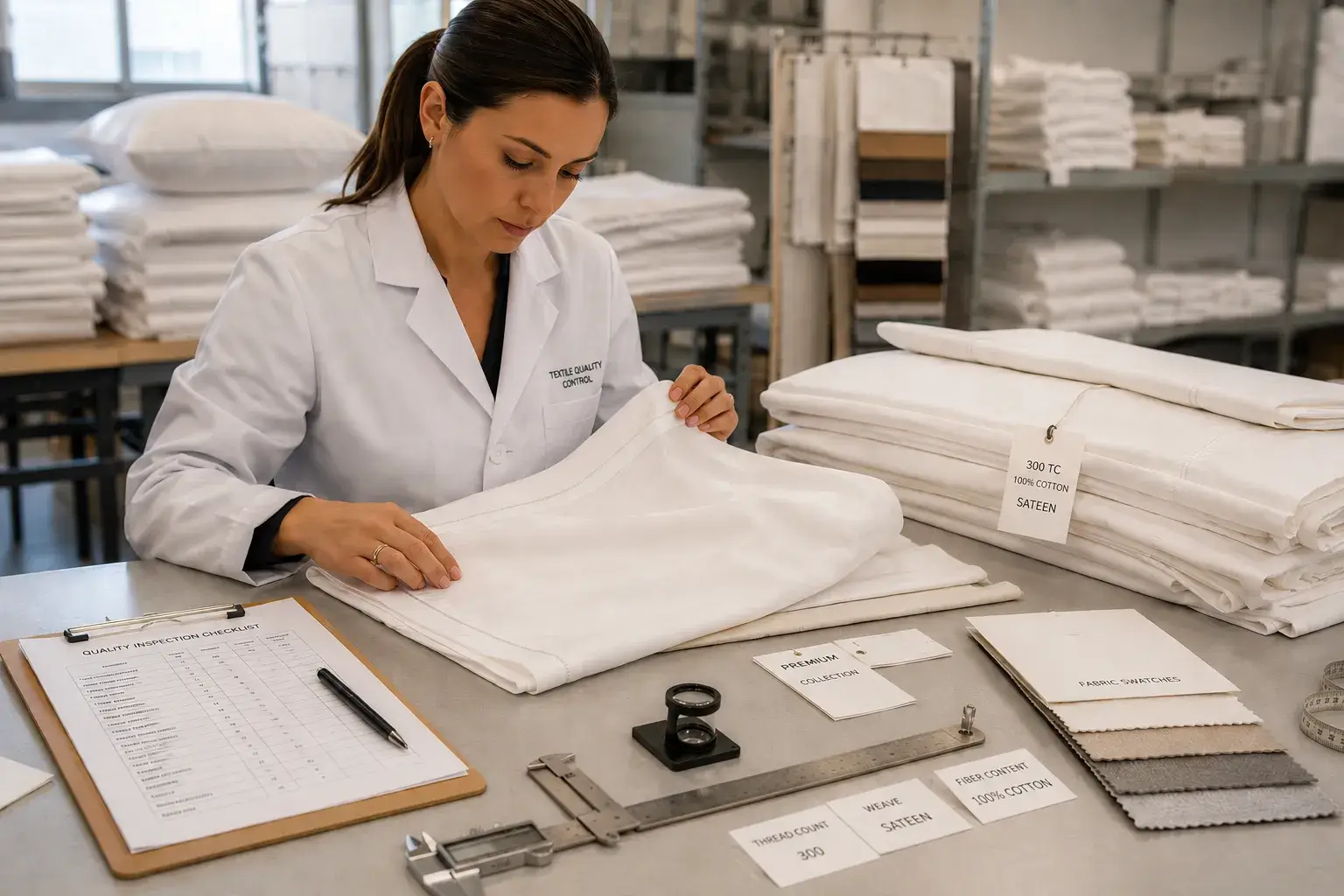
Step 1: Verify Credentials
Request a business license copy. Cross-check the company name, registration number, and address against government business registries. For Chinese suppliers, check the National Enterprise Credit Information Publicity System. For any supplier, verify that the information on their website matches what’s in official records.
Step 2: Confirm They’re Actually a Manufacturer
This is critical. Many "factories" on B2B platforms are actually trading companies — middlemen who resell from the same factories you could contact directly, adding their own margin on top. The markup varies, but it’s money that adds no quality control or product value.
Red flags that suggest a trader, not a factory:
- Unusually broad product range (bedding and electronics? That’s a broker)
- Vague or missing factory address
- Unable to answer detailed production questions (loom types, finishing equipment, dyeing processes)
- Reluctance to offer a live video factory tour
- Product photos that look inconsistent or lifted from other listings
What genuine manufacturers typically do: They invite video calls or virtual tours, list specific equipment, have staff who can answer technical questions, and specialize in a focused product range.
Step 3: Request and Test Samples
Never order in bulk from a new supplier without physical samples. Here’s the part most guides skip: don’t just feel the fabric on your desk. Run samples through your actual commercial laundry process. Evaluate them after 10–20 wash cycles for:
- Pilling
- Shrinkage (should be under 3–5%)
- Color retention
- Softness degradation
- Tear resistance
Some experienced buyers request samples under different names and email addresses to check product consistency.
Step 4: Check References
Ask the supplier for client contacts in your industry segment. Then actually call them. Ask about on-time delivery rates, defect percentages, and — most importantly — how disputes were handled.
Step 5: Start Small
Place a trial order before committing to a large contract. A supplier who performs well on a $2,000 order deserves a shot at a $20,000 one. A supplier who delivers problems on a small order will deliver bigger problems on a bigger one.
What Questions Should I Ask a Bedding Supplier Before Signing a Contract?
I’ve organized these by category. Print this out before your next supplier call.

Production Questions
- What is your monthly production capacity for my specific products?
- What is your current lead time from order confirmation to shipment?
- Do you manufacture in-house or subcontract any processes?
Pricing and Terms
- What is the unit price at my estimated volume?
- What is the MOQ per SKU?
- What are your payment terms? (Industry norm: 30% deposit, 70% upon completion with inspection rights before final payment.)
- Are prices fixed for a contract period, or subject to raw material fluctuations?
Quality and Compliance
- What is your current defect rate?
- Do you hold OEKO-TEX Standard 100, GOTS, ISO 9001, or BSCI certification? (Ask for certificate numbers and verify independently.)
- Will you allow third-party quality inspections before shipment?
- What is your return/replacement policy for non-conforming goods?
Logistics
- Which shipping terms do you support (FOB, CIF, DDP)?
- What is your contingency plan for supply chain disruptions?
- What ports do you ship from?
Customization
- Can you produce private-label products?
- Do you offer custom embroidery, weaving patterns, or packaging?
- What is the MOQ for customized vs. stock items?
The most underrated question: "Can you connect me with two or three current clients in the hospitality sector?" A supplier who refuses this request is telling you something.
Which Certifications Actually Matter for Bedding?
Four certifications come up most often in hotel bedding procurement. Here’s what each one actually verifies.
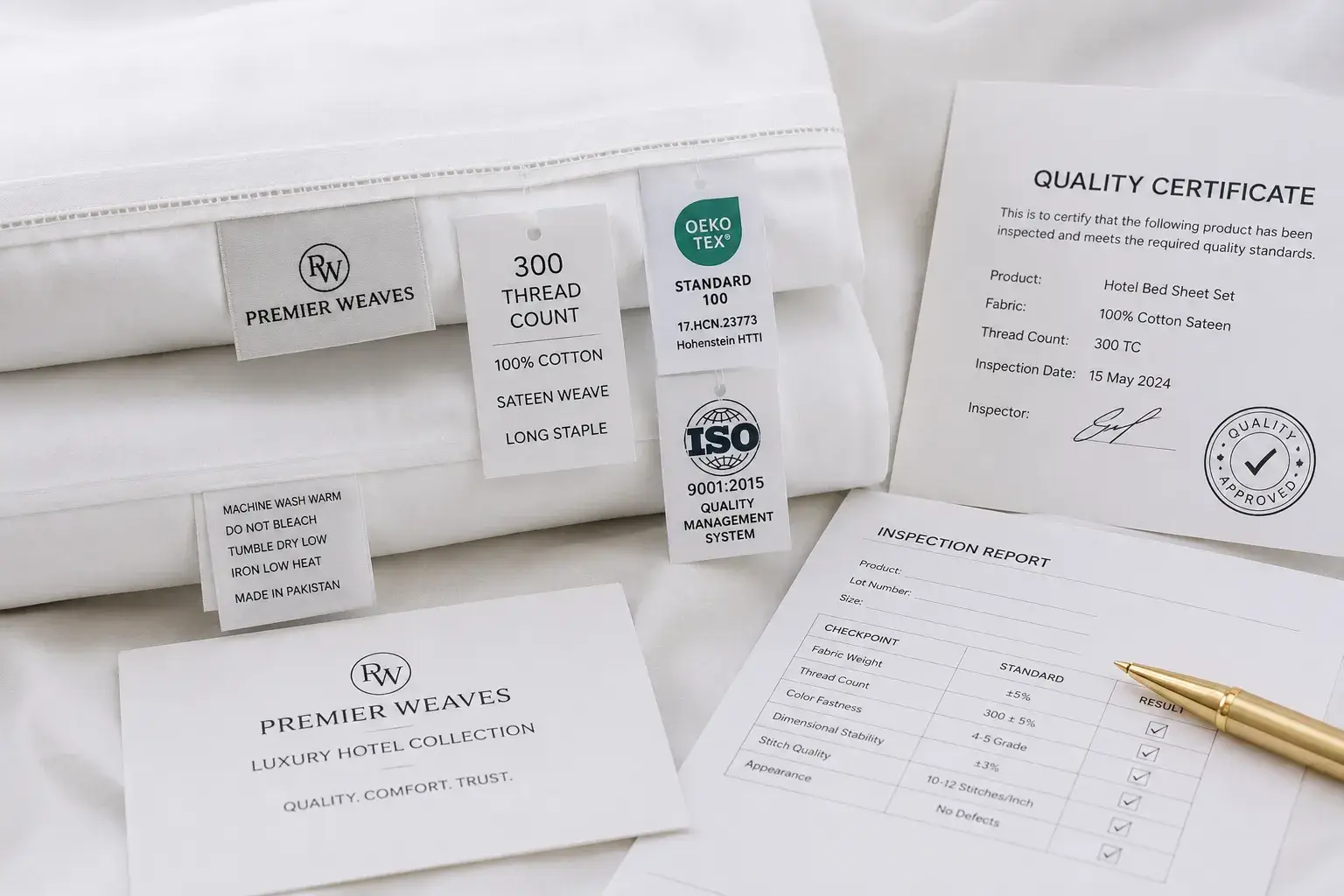
OEKO-TEX Standard 100
This tests every component of a finished product — fabric, thread, dyes, zippers — against over 100 harmful substances5. Products are classified by skin contact level:
| Class | Application | Stringency |
|---|---|---|
| Class I | Baby items | Most strict |
| Class II | Items with significant skin contact (bedding) | High |
| Class III | Items without direct skin contact | Moderate |
| Class IV | Decorative materials | Basic |
For hotel bedding, Class II is the standard I’d require. This certification works with all fiber types — cotton, polyester, blends, synthetics.
GOTS (Global Organic Textile Standard)
GOTS certifies the entire supply chain from organic farming through manufacturing. Products must contain at least 70% organic fibers6 (95% for the "organic" label). It also enforces environmental and fair labor standards.
Key distinction: OEKO-TEX tells you the finished product is safe. GOTS tells you the entire production process was ethical and organic. They’re complementary, not interchangeable.
ISO 9001
This certifies a manufacturer maintains a consistent quality management system. Not textile-specific, but it shows operational discipline.
BSCI (Business Social Compliance Initiative)
Verifies ethical labor practices in the supply chain. Increasingly required by European hotel groups.
A Warning About Certificate Fraud
Forged certificates are a known problem in international textile trade. Always verify certificate numbers directly through the issuing body’s online database:
- OEKO-TEX: oeko-tex.com/en/label-check7
- GOTS: global-standard.org certified suppliers database8
- ISO: Verify through the specific certifying body listed on the certificate
If a supplier resists providing verifiable certificate numbers, walk away.
How Do I Evaluate Bedding Quality Beyond Thread Count?
Thread count gets more attention than it deserves. Here’s what matters more for commercial bedding.
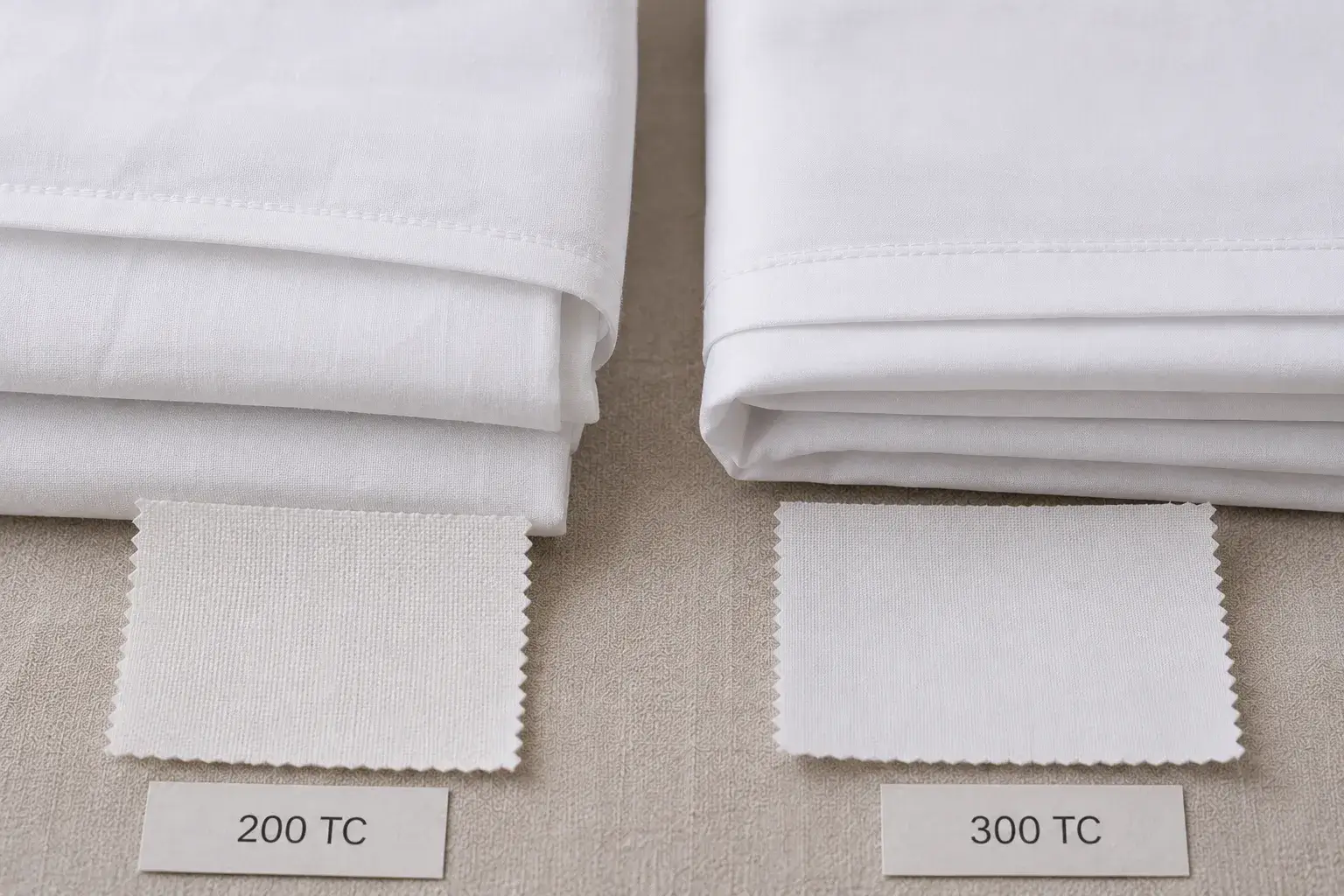
The Thread Count Myth
To fit 1,000 threads into a square inch, manufacturers twist two or more thin, weak threads together (multi-ply) and count each strand separately. The result? Heavy fabric that traps heat, pills quickly, and tears easily.
The practical sweet spot for hotel bedding is 200–400 TC in single-ply construction. A T300 single-ply sheet will outperform a T1000 multi-ply sheet in durability, breathability, and softness after washing — every time.
What Actually Determines Commercial Bedding Quality
| Quality Factor | What to Look For | Why It Matters |
|---|---|---|
| Fiber length | Long-staple cotton (Egyptian, Supima/Pima) | Stronger, smoother yarn; less pilling |
| Yarn construction | Single-ply | More durable than multi-ply at any thread count |
| Weave type | Percale (crisp) or sateen (silky) | Affects feel, durability, and laundering performance |
| GSM | 120–160 for sheets; 400–600 for towels | Measures fabric weight and density |
| Tensile strength | Request lab test data | Best predictor of commercial laundering durability |
| Colorfastness | ISO 105 rating of 4+ | Survives repeated industrial washing without fading |
| Shrinkage | Under 3–5% after washing | Ensures consistent fit over the product’s lifespan |
The Only Test That Really Matters
Wash a sample 10–20 times in your actual commercial laundry process. Then evaluate pilling, softness, shrinkage, and appearance. This real-world test is more reliable than any data sheet.
Should I Source Bedding Domestically or From Overseas?
This is a cost-versus-control decision that depends on volume, customization needs, and risk tolerance.

Domestic sourcing offers faster delivery (days, not weeks), easier communication, no customs headaches, and simpler returns. The tradeoff is higher per-unit cost — often significantly higher than equivalent products from Asian or Turkish manufacturers, depending on the product category and order volume.
Overseas sourcing offers significantly lower unit prices, broader customization, and access to specialized textile expertise. The challenges are 60–90 day lead times, shipping and customs complexity, time zone barriers, and quality risk without on-ground inspection.
The hybrid approach is what I recommend for most hotel groups: source core inventory from a thoroughly vetted overseas manufacturer. Maintain a domestic backup supplier for urgent needs and specialty items.
Post-2024 tariff increases on Chinese textiles have made geographic diversification more urgent for US buyers. Turkey, India, and Portugal have become strong alternatives — offering competitive pricing with shorter shipping times to Western markets.
What Are the Biggest Mistakes Buyers Make When Choosing a Bedding Supplier?
We see these mistakes regularly from the supplier side. Some are easy to avoid. Others are surprisingly common even among experienced buyers.
Choosing on price alone. Consider: a polycotton blend sheet costs around $6–$8 and typically survives up to 200 wash cycles. A 100% cotton sheet at $12–$15 may only last 50–60 cycles. The polycotton option costs roughly $0.035 per use. The pure cotton option costs about $0.22 per use — more than six times as much. The point isn’t that one material is better. The point is that unit price alone tells you almost nothing. You need to calculate cost-per-wash-cycle for your specific laundry conditions.
Skipping samples. This is the most common and most expensive mistake. Always test samples through your commercial laundry, not just with your hands.
Not distinguishing manufacturers from traders. A trading company adds margin without adding quality control. Learn to spot the difference.
Ignoring logistics. A great product from a supplier with unreliable shipping creates operational crises during peak occupancy. Always ask about supply chain contingency plans.
Failing to involve your laundry vendor. Your commercial laundry’s specific chemicals, water temperature, and equipment directly affect linen lifespan. A sheet that performs well in one laundry system may degrade rapidly in another. Have your laundry partner test samples before committing.
Not reading the contract carefully. Delivery timelines, defect policies, IP protection, and return procedures all need to be explicit and agreed in writing.
Over-ordering initially. Start with a trial order. Assess real-world performance. Then scale.
How Do I Negotiate Pricing and Build a Long-Term Supplier Relationship?

Negotiation Starts With Knowledge
Get quotes from at least three to five suppliers for the same specs. This gives you the market range and real negotiating leverage.
Focus on total value, not unit price alone. Ask about:
- Volume discounts at different order thresholds
- Early payment discounts (2–5% for payment within 10–15 days is common)
- Extended payment terms (Net 30 or Net 60)
- Bundled pricing across product categories
Payment Structure for International Orders
The industry standard is 30% deposit, 70% upon completion — with inspection rights before the final payment. Never pay more than 30% upfront to a new supplier. Never wire the full amount before shipment.
For shipping terms:
- FOB (Free On Board): You manage shipping from the supplier’s port. Cheaper, but requires logistics expertise or a freight forwarder.
- CIF (Cost, Insurance, Freight): Supplier manages shipping to your port. Simpler, but their shipping markup is built into the price.
- DDP (Delivered Duty Paid): Supplier handles everything to your door. Most expensive, but the least risk and effort on your end.
The Long-Term Advantage
Manufacturers give better pricing and priority service to buyers who provide consistent, predictable orders — even at moderate volumes. A hotel placing $20,000 quarterly on a reliable schedule may get better terms than one placing a single $50,000 order with no follow-up commitment.
Providing quarterly or annual demand forecasts lets suppliers plan production and pre-purchase raw materials at favorable rates. This predictability is negotiating leverage that costs me nothing.
People Also Ask
How much does hotel bedding cost wholesale?
It varies by material and order volume. Economy polycotton sheets (T180) typically cost $3–$8 wholesale. Mid-grade cotton percale (T250–T300) runs $8–$18. Luxury long-staple cotton (T300–T400) costs $15–$35+. Complete sets (fitted, flat, two pillowcases) range $15–$60. The total cost per room for a full bedding setup typically runs $80–$250 at wholesale, depending on quality tier. At an industry level, linens represent roughly $360 per room2 assuming four pars on hand — a $2 billion annual spend across the US hospitality industry.
What is the minimum order quantity for wholesale bedding?
US-based distributors often start at $500–$2,000 per order. Overseas manufacturers typically set MOQs at 300–1,000 pieces per SKU for stock items, and 500–3,000+ for customized products. Some will negotiate lower MOQs for a first trial order at a slightly higher unit price.
How do hotels keep bedding so white?
Three things: commercial-grade laundry equipment with higher temperatures and stronger detergents than home machines, bedding specifically engineered to withstand commercial laundering (polycotton blends or tightly woven cotton percale), and strict replacement schedules. When bedding begins to yellow or thin, it’s retired. This is why wash-cycle durability is the single most important supplier evaluation criterion.
How often should hotels replace bedding?
Sheets and pillowcases: every 12–18 months at high-occupancy properties, or after 200–300 wash cycles. Pillow inserts: every 12–18 months. Duvets: every 3–5 years. Mattress protectors: every 12–24 months. Most hotels maintain 3–4 par levels9 (sets per bed) to ensure clean inventory is always available while units cycle through the laundry.
Is it safe to buy bedding from Alibaba?
Yes, but only with proper due diligence. Use Trade Assurance for payments. Verify certifications independently. Order samples before bulk. Commission a third-party factory audit for orders above $5,000. Start small. And remember: Gold Supplier status is a paid badge, not proof of quality.
What’s the difference between a bedding manufacturer and a distributor?
A manufacturer produces bedding in their own factory. They offer the lowest per-unit price and the most customization, but with higher MOQs and longer lead times. A distributor buys from manufacturers and resells. They offer smaller order quantities and faster fulfillment, but at a higher per-unit cost. A trading company is a third category — a middleman who brokers deals without manufacturing or holding inventory. They add margin without adding quality control.
Conclusion
The right bedding supplier isn’t a vendor you swap out every year. It’s a partner who affects guest satisfaction, operating costs, and your property’s reputation every single day.
The buyers we enjoy working with most share a few habits. They define their specifications clearly before reaching out. They vet suppliers with samples, references, and real-world laundering tests — not just spec sheets. They calculate cost-per-wash-cycle instead of cost-per-unit. And they treat their best suppliers as partners, not interchangeable vendors.
The upfront work takes time. But it pays for itself every month in lower replacement costs, fewer guest complaints, and a procurement process that actually runs smoothly.
If you’re in the process of evaluating bedding suppliers — or want to see how we’d handle your specific requirements — get in touch with our team. We’ll send samples, walk through your specs, and give you honest answers about what we can and can’t do.
-
Ecolab’s hotel laundry data shows a 150-room hotel spends ~$75,000/year on laundry operations, with 25% ($18,750) going to linen replacement alone. Useful for understanding the real financial stakes of supplier decisions. ↩
-
Hospitality Technology reports that US hotels spend ~$2 billion annually on linens ($360/room at 4-par), with 20–30% of inventory lost each year to theft, damage, and poor tracking. Essential context for why supplier quality directly impacts operating costs. ↩ ↩
-
Alibaba’s official Trade Assurance page explains how the escrow-style buyer protection works — holding your payment until you confirm product quality and on-time shipment. Essential reading before placing any international order through the platform. ↩
-
Shopify’s Alibaba sourcing guide covers verified supplier types, RFQ best practices, payment methods, and the role of sourcing agents in international procurement. A practical starting point for first-time importers. ↩
-
The official OEKO-TEX Standard 100 page explains the four product classes, testing criteria, and what the certification guarantees about harmful substance levels in finished textiles. Important reading before requiring this certification from suppliers. ↩
-
The Global Organic Textile Standard (GOTS) official site details the 70%/95% organic fiber thresholds, environmental processing criteria, and social compliance requirements that make this the leading organic textile certification worldwide. ↩
-
OEKO-TEX’s official Label Check tool lets you verify any OEKO-TEX certificate number in seconds. Use this to confirm whether a supplier’s claimed certification is current and valid. ↩
-
GOTS maintains a searchable public database of all certified suppliers worldwide, including their location, certified products, and scope certificates. Use this to independently verify any supplier claiming GOTS certification. ↩
-
1Concier’s guide to hotel linen par levels explains why 3–4 sets per bed is the industry standard, how under-stocking accelerates wear and increases costs, and how to calculate the right par level for your property’s occupancy patterns. ↩